• Skip to main content

In House Plumbing Company

Schedule an Evaluation
Evaluation
Call Now (972) 992-1777

  • Home
  • Cast Iron Pipe Replacement
  • Pricing
  • Process
  • Case Studies
  • Warranty
  • Resources
    • About
    • Take Our Quiz
    • Before You Decide
    • Financing
    • Foundation Repair Guide
    • Businesses We Trust
    • Professional Affiliations
    • Blog
  • Reviews
  • Service Area
    • Plano
    • Rowlett
    • Wylie

Why Doing Cast Iron Replacement in Stages Can Cost Significantly More Over Time

This case study examines how completing under-slab cast iron sewer replacement in multiple stages increased total cost and disruption compared to completing the full replacement in a single construction event. It illustrates why underground work does not divide evenly when split into phases.

Location

Carrollton, Texas (75007)

The Situation

In this case, the homeowner was considering completing the sewer work in multiple stages instead of completing everything at one time.

On the surface, staged work can sound reasonable.
It can feel like you are spreading cost out over time.

But with underground cast iron sewer systems, staged work does not simply divide the cost evenly.

It creates more cost, multiple construction events — and changes everything.

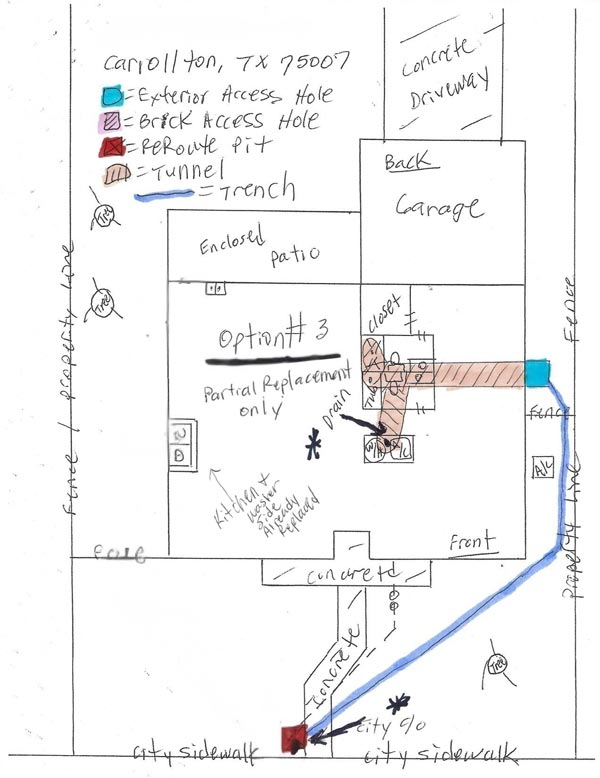
To help explain this clearly, we created diagrams showing what each path would realistically look like for this specific home.

Option 1 — Full Replacement (One Construction Event)

Before looking at staged work, it’s important to understand what full replacement looks like when everything is completed at one time.

In a full replacement scenario, the entire failing cast iron system is addressed in one well-planned and very controlled construction event.

Excavation, tunneling, plumbing installation, inspection, and backfill/restoration all happen once.

This approach eliminates future mobilization costs, repeat disruption to the property, and repeated risk exposure.
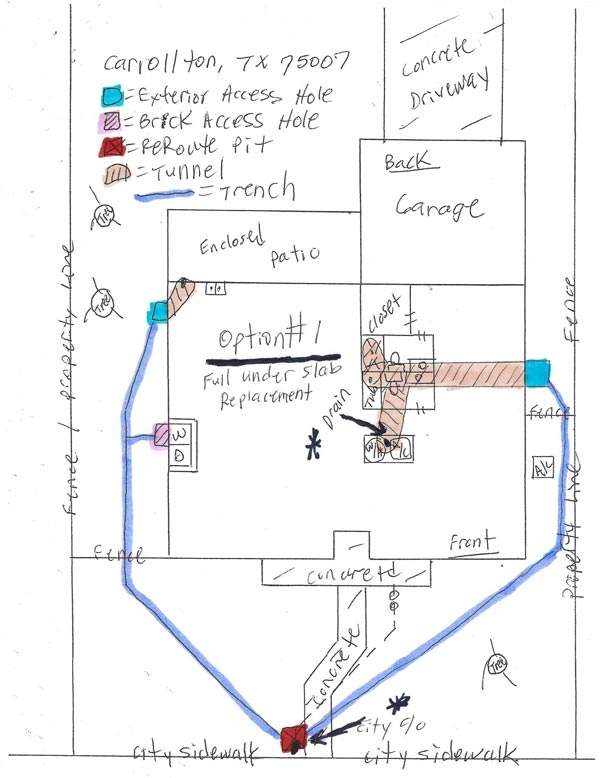
Option 1 Diagram - Full Replacement

When work is completed this way, the system is solved in one project instead of multiple separate projects over time.

Option 2 — Stage 1 Partial Replacement (First Construction Event Only)

Now compare that to what staged work looks like, starting with only part of the system being replaced.

At this stage, part of the failing system is still left in place.

Even though some new pipe is installed, deterioration continues in the remaining cast iron.

This means future work is guaranteed.
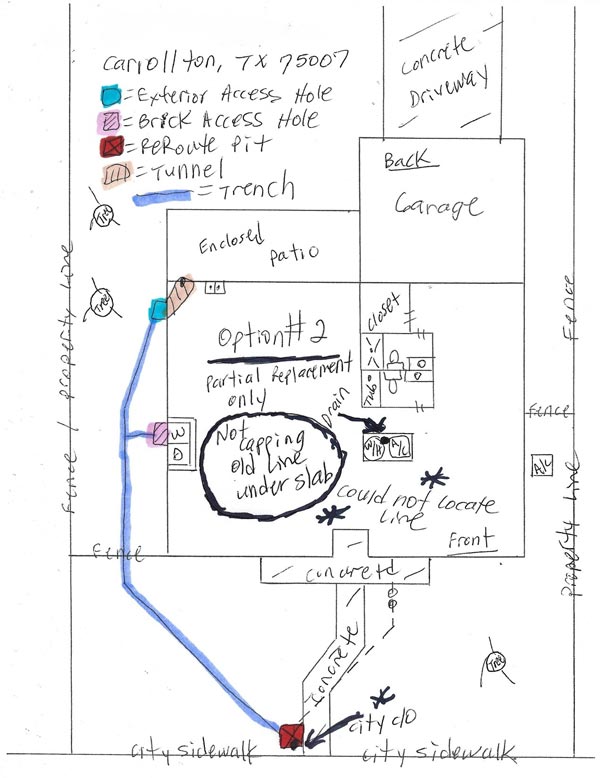
Option 2 Diagram - Partial Replacement

At this point, the homeowner has already paid for:

  • Mobilization
  • Excavation setup
  • Access creation
  • Labor setup and teardown
  • Inspection coordination
  • Site restoration

And this is only for part of the system.

Option 3 — Stage 2 Later (Second Construction Event)

When the remaining cast iron fails later — which is guaranteed — the second stage becomes a completely new construction event.

This is where many homeowners are surprised.

The second stage is not just paying for “the rest of the pipe.”

It means paying for a second round of:

  • Job setup
  • Mobilization
  • Access creation
  • Excavation or tunneling
  • Permits and inspections
  • Site disruption again

Option 3 Diagram - Later

At this point, the project has been performed twice from a construction standpoint.

The Part Most People Don’t Think About — Life Disruption

Cost is only one part of staged work.

The other major factor is disruption to the home and the people living in it.

Every underground sewer project has disruption to using the water and sewer system, as well as a minimum timeline built into it because of inspection requirements.

Inspections must be scheduled for the day after plumbing work is completed and could take all day to complete while you are not able to run water or use the sewer system.

There is no way to complete plumbing work and pass inspection on the same day.

Even the smallest jobs realistically take at least two days, and that is uncommon.

Most real-world timelines look like this:

Day 1 — Excavation / tunneling
Day 2 — Plumbing installation + possible additional digging
Day 3 — Inspection (sometimes backfill can begin)
Day 4 — Backfill and restoration (very common)
Day 5–6 — Possible delays due to weather, soil conditions, or project size

Most jobs of any meaningful size are 3–4 day projects, and sometimes longer.

When work is staged, homeowners often go through this entire disruption cycle twice.

Which raises a simple but important question:

Why live through a 3–4 day construction event two separate times if it can be solved in one?

What This Meant in This Real Job

When comparing staged work versus completing everything at once:

The total combined cost of staged work in this case would have been 33% — almost $7,000 — higher than completing the full replacement in a single project.

Not because anything was done wrong.
Not because anyone was being dishonest.

Because doing underground work in pieces always costs more than doing it all at once.

The Important Reality Most People Don’t See

When a project starts down the staged repair or replacement path:

There is no clean way to reverse course later.

If you later decide to complete full replacement, you are not “continuing the same project.”

You are starting a second project — while the cost of the first one still exists.

It can get worse if you start replacing pipe where it sits but later realize a reroute was the better option.

Then you’re stuck either continuing a very expensive replacement path — or starting over and abandoning pipe you already paid to install.

In many real situations, finishing the replacement where it sits ends up costing more than just rerouting everything correctly from the start. Unfortunately, we have seen this all too many times.

What We Want Homeowners To Understande

When cast iron reaches the stage where partial replacement is being considered:

  • Remaining pipe is usually already deteriorating
  • Future failures are guaranteed
  • Future construction is guaranteed
  • Total lifetime project cost will increase when split into stages
  • Planning and replacing everything correctly one time is always the most cost-effective long-term way to handle under-slab / underground cast iron replacement

Important Advice If You Are Considering Staged Work

If you are thinking about completing underground sewer work in stages, make sure you:

✔ Get an estimate for the entire project completed at one time
✔ Get separate estimates for each individual stage — i.e., the one you want to do now and what will be needed later
✔ Add the staged costs together and compare them to the full replacement cost

Do not assume staged work equals:

Cost of Stage 1
PLUS
“The difference” to full replacement later

Underground construction doesn’t work that way.

Our Philosophy

We believe homeowners should have all information available to make the most informed decision possible.

When it comes to doing work in stages, we will always explain both short-term and long-term realities — even if that means recommending a solution that is less profitable for us over time.

If you ever want to understand how staging versus full replacement might apply to your specific home, we are always willing to explain the real long-term pros and cons.

Related Resources

If you are evaluating full under-slab cast iron pipe replacement, you may also find these helpful:

View our Cast Iron Pipe Replacement Cost page

Review our Warranty Information

Explore additional Case Studies

Quick Links

  • Home
  • Cast Iron Pipe Replacement
  • Pricing
  • Process
  • Case Studies
  • Warranty
  • Resources
    • About
    • Take Our Quiz
    • Before You Decide
    • Financing
    • Foundation Repair Guide
    • Businesses We Trust
    • Professional Affiliations
    • Blog
  • Reviews
  • Service Area

Service Areas

CITY1
CITY2
CITY3
CITY4
CITY5

See Complete Service Area

Contact Us

In-House Plumbing Company

5903 Curtis Dr.
Allen, Texas 75002

(972) 992-1777


Hours of Operation

Mon – Fri: 8 AM – 5 PM
Closed 12 PM – 1 PM for Lunch
Sat: Closed
Sun: Closed


William Hoyle M - 5556

Connect With Us

Copyright © 2026- | Privacy Policy | Terms & Conditions | Design by: Big West Marketing

Click to Call

Tap to Text