Important Note About Our Services
In-House Plumbing Company specializes exclusively in full residential sewer pipe replacement, particularly aging cast iron sewer systems in older homes.
We do not perform standalone sewer inspections, leak detection services, or plumbing repairs.
This article is provided as educational information to help homeowners understand the limitations of sewer camera inspections when evaluating plumbing problems.
A sewer camera is a valuable tool to help determine if there’s a problem with your home’s sewer system.
Maybe you noticed a nasty sewer gas odor. Or maybe your water isn’t draining as fast as it used to. Or worse, you’ve got an overflowing toilet.
If you’re like most people, you’ll call a plumber for help. And when that plumber comes to your house, more than likely, he’ll perform a sewer camera inspection.
But it’s important for you, the homeowner, to know what a sewer camera inspection can find and what it can’t. Armed with this information, you will know if the plumbing company you hire to come out and inspect your pipes is ripping you off or not.
What is a Sewer Camera Inspection?
First, let’s cover what a sewer camera inspection is. Typically sewer lines are installed under the foundation of your house. There’s the concrete slab which is about 4 or 5 five inches thick and then about 2 feet or so of dirt above the pipe.
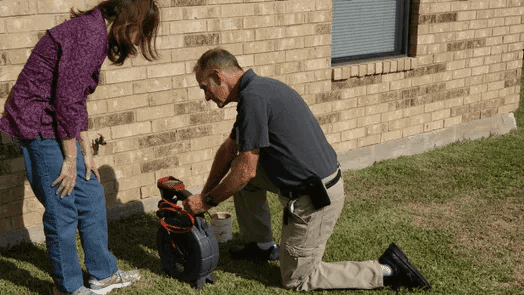
To inspect the pipes and find possible problems, a special sewer video camera head connected to a flexible cable is inserted into the main sewer line cleanout, or in some cases, the vent stack and snaked through the pipes. Then the plumber watches on a monitor at ground level to see what’s going on in your pipes.
Sewer cameras are commonly used by plumbers to help determine what may be happening inside a sewer system. However, it’s important to understand that there are some problems a camera alone simply cannot find.
What a Sewer Camera Inspection Can’t Do
Despite what many in the plumbing industry think, there are limitations to what a sewer camera sees inside your sewer lines. But there is one thing a sewer camera absolutely cannot see.
Locate Leaks
A sewer camera alone cannot determine if you have a leak or to locate a leak or leaks in your sewer lines. In fact, this is so important, it bears repeating.
While it’s a useful as a secondary tool in a leak location test, a sewer camera by itself cannot be used to determine if you have a leak or to find a leak.
4 Reasons Why a Sewer Camera Can’t Locate a Leak
- A leak is water escaping the pipe through a hole, break, or crack. Since the camera is inside the pipe, it cannot see the outside of the pipe. Meaning, it can’t see if something is leaking OUT of the pipe. It can only show what is going on INSIDE the pipe.
- The plumber is looking at a monitor displaying what the camera “sees.” So the plumber has to interpret, or guess, what he’s seeing. He might think he see something that looks like a hole, break, or crack in the pipe. But keep in mind, this is your sewer system we’re talking about. This is where your waste flushes and runs through. Trust us when we say it does not look good. And all that gunk and waste makes it hard to tell if something is a leak based solely on what can be seen on the monitor.
- Sewer pipes are usually one of two types: cast iron or PVC, both thick-walled pipes. So something very possibly might look like a hole or a crack or a break. But because the walls of the pipe are so thick, it’s possible what the plumber is seeing does not go all the way through the pipe so no water is leaking out at all. The result: no leak.
- Particularly with cast iron, but this could also be true for PVC, there are years of buildup on the walls of the pipe. Calcium, soap scum, grease, debris… you name it, builds up on the walls of your sewer pipes. So any cracks or holes the plumber sees could very well be in the buildup and not the actual pipe.
We estimate about 95% of plumbing companies in the Dallas area are using a camera as their primary tool to locate a leak. They come in, run an inspection with just a sewer camera and then tell you you have a leak.
But keep in mind, what may look like a leak on camera may not actually be a leak. And vice versa.
Look at this image taken by another plumbing company and shown to a homeowner.
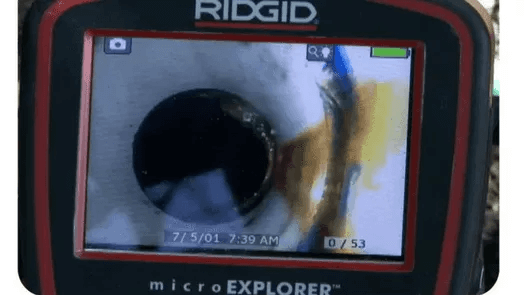
This is cast iron pipe with a PVC repair. The plumber told the homeowner he had two leaks based on the image alone. However, further testing later showed there were no leaks at all, and the system was draining properly.
What a Sewer Camera Inspection Can Do
While a sewer camera cannot find leaks, there are certain situations where the camera alone is effective.
Locate Lines
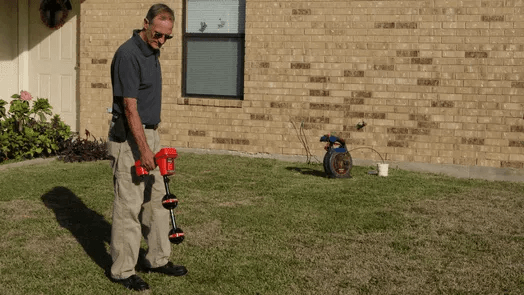
Sewer cameras have location devices that send out a signal. Using a special signal receiver above ground, plumbers can pinpoint where the camera is underground.
Drainage or Stoppage Issues
We call this your “sewer is not working as it is designed to work.”
Sewer pipes work using the power of gravity. The pipes flow downhill so when something goes into the pipe—waste, debris, water—it flows or drains down through your piping system and ultimately ends up at your city’s waste treatment center or septic tank, depending on your particular situation.
However, if something is causing your system to not work properly, a plumber may use a sewer camera to help identify what may be causing the problem. In many cases this can reveal stoppages, blockages, roots, mud, broken pipe, or other drainage problems.
Keep in mind a sewer camera cannot determine the actual condition of cast iron pipe. See our blog post “Determining Cast Iron Pipe Integrity” to learn more.
PVC or Cast Iron Pipe
Plumbers can determine what type of system you have by running a sewer camera inside the pipes.
Sewer System Connections
With a sewer camera, plumbers can see fittings, tees, and other types of connection. Plumbers can also use the camera at connections while running water to observe how water flows from one line to another.
Unnecessary Plumbing Repairs
Depending on your situation, a sewer camera inspection alone may not be adequate in finding potential problems. And it is not at all adequate if it’s leaks they are looking for.
The most important thing to know is if a plumbing company does a leak location test with a camera as the only or primary tool, it’s very possible you’re being told there are leaks when there are none. If that’s the case, you could end up paying for repairs you don’t need.
If a plumbing company claims they found a sewer leak using only a camera inspection, it may be worth asking additional questions about how that determination was made.
Understanding the limitations of sewer cameras can help homeowners make better decisions when evaluating plumbing recommendations.